The Signal: A Haunted Hotel's Courtroom Drama, Snooki's Ghost-Hunting Debut, and AI Comes for Paranormal Investigation
October 13, 2026 · Pharos Paranormal Society
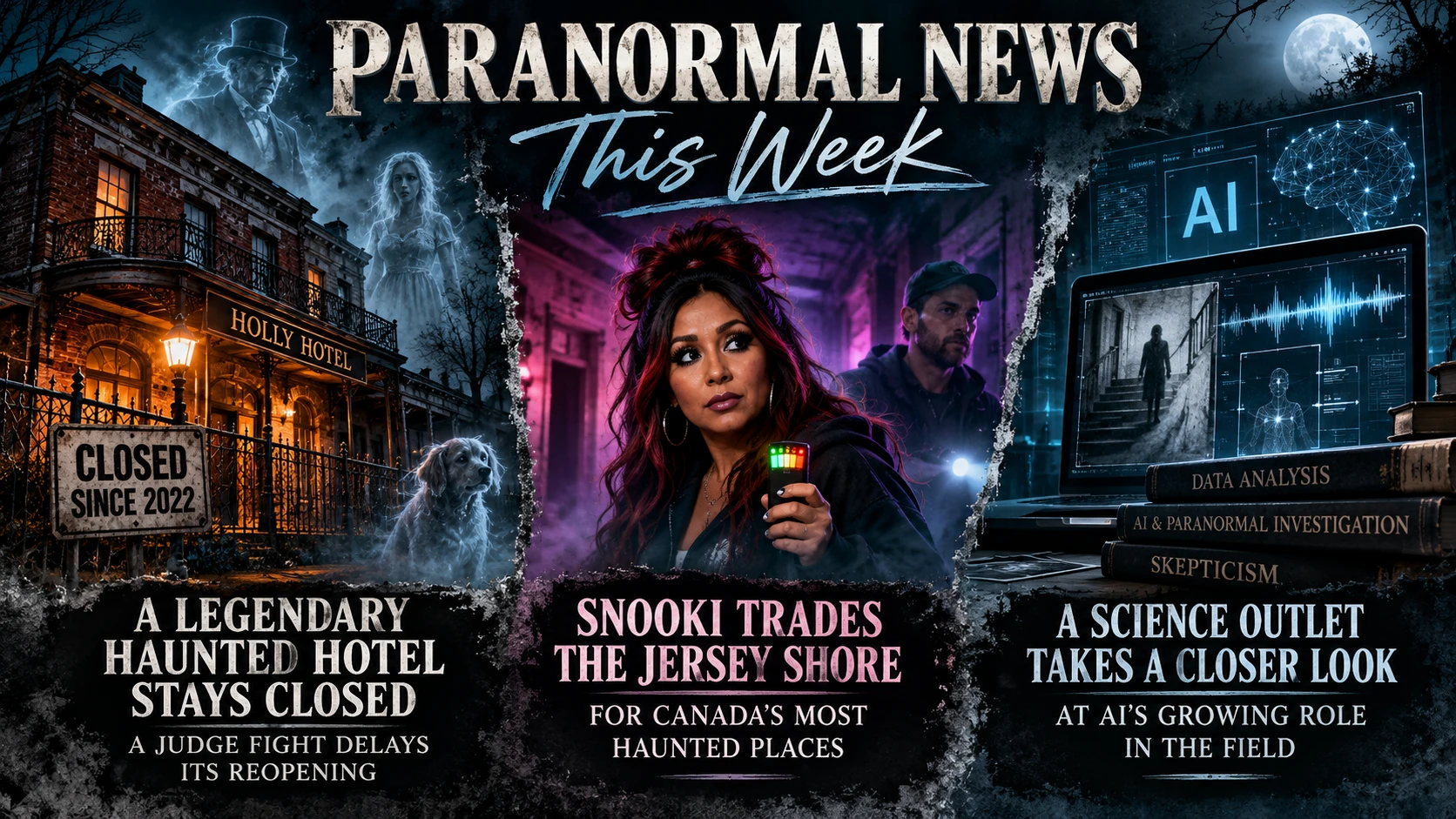
No ordinary person’s unexplained encounter made the cut this week — we went looking, same as every week, and came up empty on anything we could verify through a legitimate outlet rather than a listicle mill. Instead: a legendarily haunted Michigan restaurant’s four-year closure gets even more tangled in court, a reality TV veteran becomes the latest celebrity to pick up an EMF meter, and a respected science outlet takes a hard, skeptical look at how artificial intelligence is actually showing up in paranormal investigation. Every claim below is sourced — links at the bottom so you can read the original reporting yourself.
A Legendarily Haunted Hotel Stays Closed as a Judge Fight Delays Its Reopening
The Holly Hotel, a 19th-century landmark restaurant in Holly, Michigan, has been closed since a fire damaged it in 2022 — and it’s still closed, not because of the fire damage itself, but because of what’s turned into one of the pettiest-sounding, longest-running property disputes in the state. During reconstruction, a survey found that part of the hotel’s west wall and roof eaves extend several inches onto the vacant lot next door, which a neighbor named Jeremiah Roberts bought in 2023. Roberts objected, repair crews got blocked, and the hotel’s owners ended up suing him in Oakland County Circuit Court. Nearly three years of mediators, status conferences, and a bench trial later, the case is still not resolved: both sides reportedly agreed to settlement terms at one point but couldn’t finalize the language, and the case is now headed to a new trial in December, after the neighbor’s side recently moved to have the presiding judge, Jacob Cunningham, removed from the case over how he handled a settlement hearing.
All of this is happening to a building with an unusually well-documented haunted reputation, one the Kutlenios family (the hotel’s owners) has openly embraced for years rather than downplayed. The hotel’s own site catalogs a cast of recurring presences: Mr. Hirst, the original hotelier, said to announce himself with cigar smoke and dislike noise and renovations (an occupational hazard, under the circumstances); Nora Kane, a hostess tied to a lingering floral perfume who’s said to show up most often in wedding photographs; a mischievous child ghost blamed for a wandering kitchen cleaver; and even a phantom dog, Leona, heard trotting through the halls. It’s the kind of lore that’s made the Holly Hotel a recurring entry on “most haunted in Michigan” lists for years. Right now, though, the only presence anyone can confirm is a few inches of roofline and a judge who may or may not still be hearing the case by December.
A building known for its ghosts sitting empty while the living fight over a property line for going on four years has a certain dark comedy to it — the hauntings, whatever you make of them, have been remarkably patient. The actual news here isn’t paranormal at all, but we’re tracking it because the hotel’s reopening (or lack of one) directly affects whether anyone gets to investigate it again.
Snooki Trades the Jersey Shore for Canada’s Most Haunted Places
Snooki: The Paranormal Rookie, an eight-episode Crave original starring Nicole “Snooki” Polizzi, premiered October 2. The premise is straightforward reality-TV formula: Polizzi, by her own admission a lifelong fan of the paranormal with zero formal investigative training, visits a run of Canada’s reportedly haunted locations paired with Kevin Whitaker, a Canadian psychic medium who runs Dark Dealings Paranormal, building up to a solo investigation at a well-known haunted site by the finale. Bell Media hasn’t named most of the specific locations publicly, but the format — untrained celebrity, professional medium chaperone, escalating difficulty — is a familiar one for the genre at this point. “The ghosts better watch out because this mawma is coming for them,” Polizzi said in the show’s announcement.
It’s produced by Buck Productions with My Entertainment, and the people behind it are candid about what they’re selling: Bell Media’s VP of content development called “zero training and 100% passion” the “perfect recipe” for Polizzi’s next hit, and the executive producer credited her willingness to “dive headfirst into the unknown” as the appeal, not any particular investigative rigor.
We don’t say this to be snobbish about it — reality television has introduced plenty of people to this field who later took it seriously. But it’s a useful contrast to the Halifax Paranormal Symposium lineup we covered last week, which leaned hard into researchers with actual credentials. Both things can be true about this field at once: it runs on celebrity curiosity and on people spending years studying EMF correlation data, often in the very same month.
A Science Outlet Takes a Clear Look at AI’s Growing Role in the Field
IFLScience published a detailed look on October 6 at how paranormal investigators are actually using artificial intelligence, and it’s worth reading in full rather than summarizing as either hype or dismissal — the piece does neither. Investigators are reportedly using AI tools to spot environmental patterns and anomalies in sensor data that would be too subtle for a person to catch, and to “enhance” audio, video, and photo evidence, a use the article flags as particularly risky, since AI image and audio tools are well known to generate content that was never actually there. According to Tom Clark, a lecturer at the University of Sheffield, the most common actual use he’s observed isn’t investigation at all — it’s generating social media content and advertising for investigation groups.
The more unsettling use case the article raises: people running classic cases, like the Enfield poltergeist evidence, through AI chatbots and treating what comes back — a “detected” voice, a shape in an image — as a kind of automated finding. The article is openly skeptical of this. It cites a 2024 MIT paper showing that belief in AI predictions correlates with paranormal belief generally, and that people will rate even fabricated AI predictions as valid. Paul Sinclair, an independent researcher quoted in the piece, argues AI has a legitimate place in the field and that its role will only grow, but warns specifically against using it to assign a cause to an unexplained event or as a replacement for a trained person’s judgment — reading a witness’s demeanor, for instance, isn’t something a model can do.
This is a more honest piece than most “ghost hunters use AI now” coverage we’ve seen, because it actually distinguishes between AI as a data-analysis tool (plausible, if you understand its limits), AI as a marketing tool (already happening, not controversial), and AI as an oracle you ask whether a poltergeist is real (a bad idea, and the piece says so plainly). We’d rather our own field get this reputation for self-awareness than the alternative.
Got a location, a case, or a strange find of your own? Send it our way — we go where the evidence points.
Sources
- ABC12 (WJRT) — “Historic Holly Hotel stuck in legal battle over property line”
- Tri-County Times — “Holly Hotel court case scheduled for new trial in December”
- Holly Hotel — “Our Ghosts”
- Bell Media — “Ghosts, Goblins, and Gaba-Ghouls! Crave Greenlights Reality Ghost-Hunting Series Snooki: Paranormal Rookie”
- iPhone in Canada — “What’s New on Crave: October 2026”
- IFLScience — “Ghost Hunters Are Embracing AI In Surprising Ways, And It’s Changing The Face Of Paranormal Investigation”